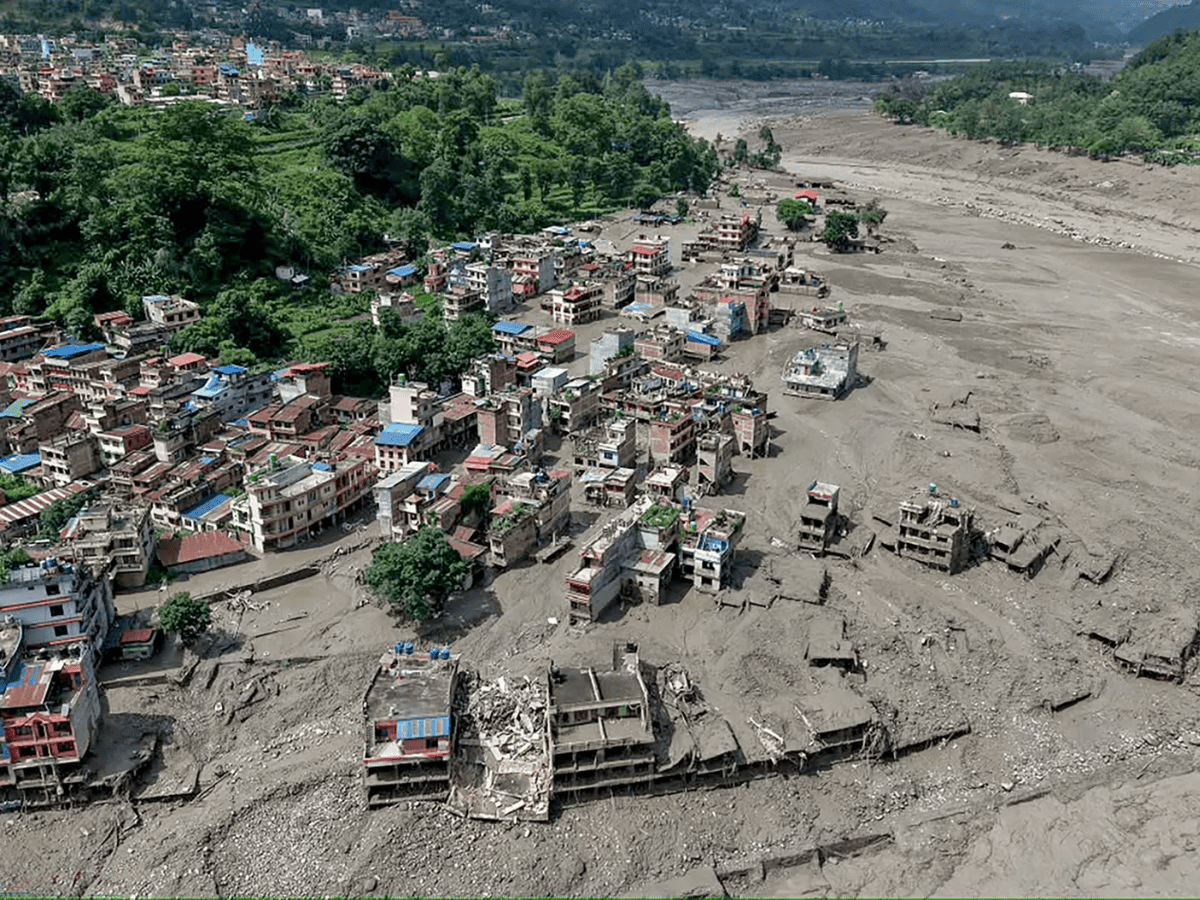
A devastating flash flood struck Nepal on August 26, 2026, after a major glacial collapse and landslide occurred in the Himalayan region near the Nepal-Tibet border. A huge mixture of ice, rock, mud and water was released into mountain river channels. As a result, communities and critical infrastructure along the river system were severely damaged. The disaster was particularly destructive because the floodwater was released suddenly and travelled rapidly downstream.
How Did the Flood Begin?
The disaster was initiated high in the Himalayas, where a substantial section of glacier and underlying rock collapsed. The falling ice and rock were carried into the Lhende Khola river system, where a temporary blockage was formed by the debris.
When that natural barrier failed, a powerful surge of water, mud and rocks was released downstream. The flood then entered the Bhote Koshi and Trishuli river systems, carrying enormous amounts of sediment through the valleys. Water levels in the Trishuli were reported to have risen by as much as nine metres within about 30 minutes.
Was an Earthquake Responsible?
Initially, an earthquake was suspected to have triggered the event. However, that explanation was later revised.
According to the US Geological Survey, the seismic signal that was detected was produced by the landslide itself rather than by an earthquake that caused the landslide. The collapse was powerful enough to register as a seismic event of about magnitude 5.2.
Therefore, the evidence currently points to a glacial and rock collapse as the initiating event, rather than an earthquake.
Why Was the Flood So Destructive?
The flood was made particularly dangerous by its combination of speed, volume and debris. Instead of ordinary river flooding caused by prolonged rainfall, a large amount of material was suddenly released from a high-altitude mountain environment.
Consequently, water was mixed with rocks, soil, ice and other debris. Roads and bridges were washed away, while buildings and hydropower facilities were buried or destroyed. Access to affected communities was also made more difficult because important transport routes were damaged.
The absence of heavy rainfall at the time also meant that the danger was not immediately obvious to many people downstream. This contributed to the difficulty of preparing for the rapidly developing flood.
What Does It Mean for Nepal?
The disaster has highlighted the growing risks faced by Himalayan communities as mountain environments become increasingly unstable. Scientists have warned that warming temperatures can contribute to glacier loss and instability in high-altitude regions, although the precise role of climate change in this particular collapse is still being studied.
Meanwhile, rescue and recovery operations have continued. Two workers were rescued alive from a hydropower tunnel nine days after the flood, showing why searches are still being conducted in damaged areas.
For Nepal, the disaster has reinforced the importance of stronger monitoring, early-warning systems and emergency planning in vulnerable Himalayan valleys.